

Shopping online can feel overwhelming when you can’t tell if glowing reviews are real or if that countdown timer is actually pressuring you into a bad decision. AI tools now offer a solution by scanning through product reviews and website claims to spot red flags that humans might miss. These systems look for patterns in language, check for suspicious details, and compare tactics against known fraud methods.

AI can process thousands of reviews to find fake patterns and identify common pressure tactics like “limited time offers” that scammers use to rush people into quick decisions. The technology examines word choices, timing of posts, and other clues that point to dishonest content. This helps shoppers make better choices without spending hours researching every purchase.
Understanding how these AI tools work gives you power as a consumer. When you know what to look for and how technology can help, you can shop with more confidence and avoid falling for common tricks that cost people billions each year.
Table of Contents
Key Takeaways
- AI tools analyze patterns in product reviews and website language to detect fake content and pressure tactics
- These systems identify specific fraud indicators like urgency language, suspicious links, and manipulative offers
- AI-powered fraud detection helps consumers make safer decisions but works best when combined with human judgment
Techniques for Detecting Fake Product Reviews With AI

AI systems use multiple approaches to identify fake reviews, from examining word choices and writing patterns to tracking reviewer activity and rating inconsistencies. These techniques work together to flag suspicious content that manual review processes might miss.
Analyzing Language Patterns and Repetitive Phrases
AI tools scan review text for unusual patterns that signal fake content. Natural language processing identifies when multiple reviews use identical phrases, similar sentence structures, or overly generic descriptions that lack specific product details.
Machine learning models examine word choice and grammar to spot differences between authentic and fabricated reviews. Research shows AI-generated fake reviews tend to be easier to understand but less specific than genuine ones. They often avoid concrete details about product performance or personal experiences.
The technology flags reviews with excessive promotional language or suspiciously perfect grammar. It also detects when groups of reviews repeat the same talking points using slightly different wording. These patterns emerge when paid reviewers or bots try to boost a product’s rating.
Detecting Anomalies in Reviewer Behavior
AI examines reviewer activity across platforms to find suspicious patterns. The systems track how often someone posts reviews, which products they rate, and the timing of their submissions.
Warning signs include accounts that post many reviews in a short period, reviewers who only rate products from one brand, or clusters of reviews appearing simultaneously for the same item. AI also flags reviewers whose ratings consistently differ from the majority opinion without reasonable explanation.
The technology builds relationship graphs connecting reviewers, reviews, and products. This reveals coordinated campaigns where multiple accounts work together to manipulate ratings. AI monitors whether reviewers have verified purchases and compares their activity against normal user behavior patterns.
Sentiment Analysis and Score Manipulation
AI measures the emotional tone in review text and compares it to the star rating given. Mismatches between positive language and low ratings, or negative complaints paired with high scores, trigger alerts.
The technology identifies when review scores cluster unnaturally. Authentic products typically show a range of ratings, while manipulated items often have suspiciously uniform five-star or one-star reviews.
AI tracks rating distributions over time to spot sudden spikes that don’t match sales patterns or product changes. It also flags reviews where the sentiment expressed doesn’t align with typical customer experiences for that product category.
Machine Learning Models for Identifying Fake Reviews
Supervised machine learning systems train on datasets of confirmed fake and authentic reviews. These models achieve approximately 90% accuracy in detection by learning distinguishing features from labeled examples.
The systems combine multiple data types:
- Text features: Word patterns, review length, linguistic style
- Behavioral features: Posting frequency, account age, purchase verification
- Time-based features: Review timing, seasonal patterns, coordination signals
- Network features: Connections between reviewers, products, and merchants
Deep learning techniques process this information simultaneously, updating their detection capabilities as new fake review tactics emerge. The models work continuously, scanning platforms in real-time rather than waiting for manual reporting.
How AI Evaluates “Limited Time Offer” Claims
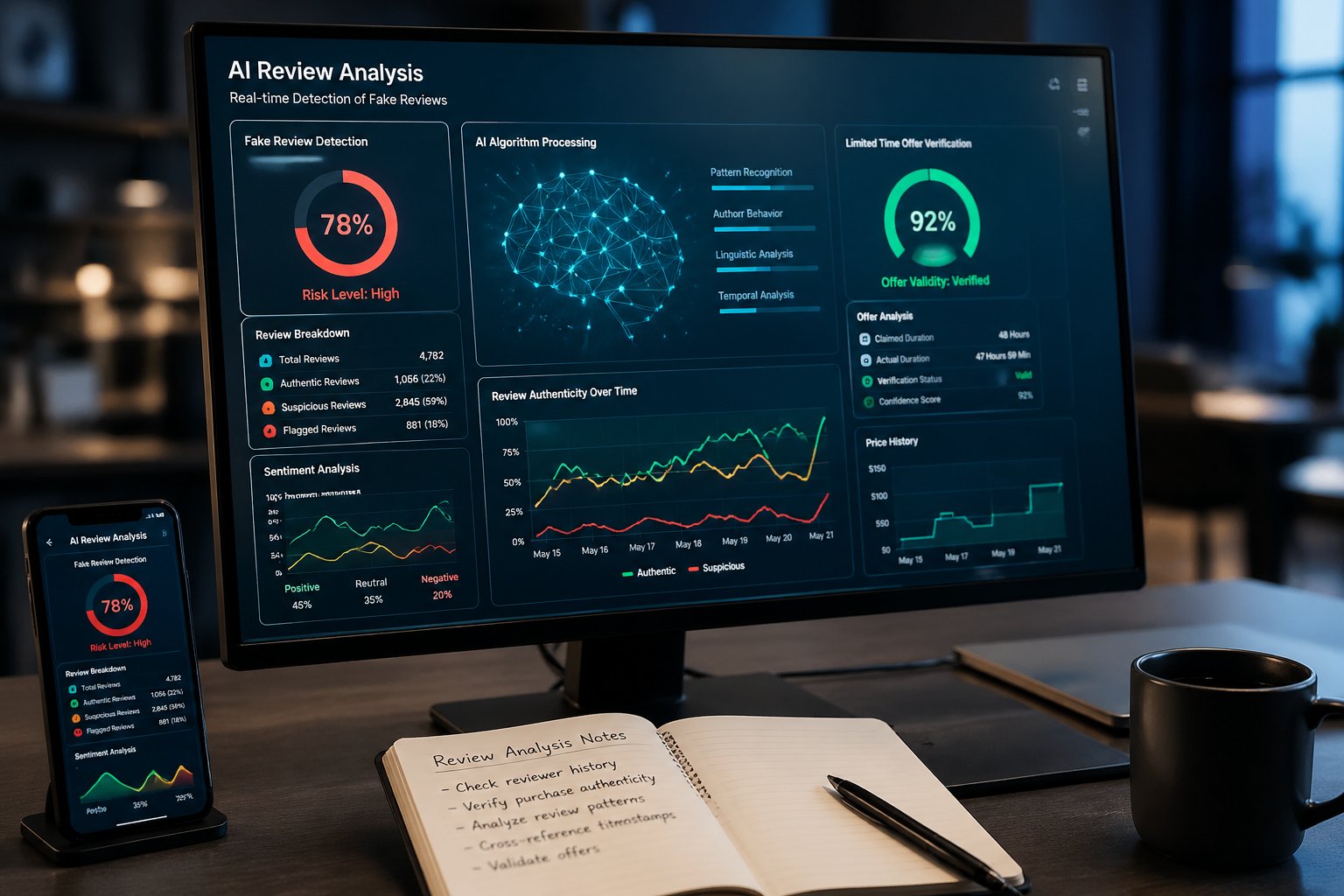
AI tools examine whether “limited time offers” are genuine deals or manipulative tactics by analyzing language patterns, comparing promotion histories across multiple sites, and monitoring how countdown timers behave over time.
Recognizing Psychological Pressure Tactics
AI systems scan promotional text for specific markers that indicate pressure tactics. These markers include urgent language like “expires today” or “last chance,” along with scarcity claims such as “only 2 left in stock.”
The technology identifies common fraud indicators:
- Time-sensitive phrases that create artificial urgency
- Action-forcing language with imperatives like “act now” or “don’t miss out”
- Consequence warnings about missing the deal
- Emotional manipulation using fear or excitement
AI tools compare the intensity and frequency of these elements against known patterns from legitimate promotions. Fraudulent offers typically combine multiple pressure tactics in a single message. They also use more extreme language than standard marketing.
The analysis assigns confidence scores to each detected tactic. Higher scores indicate stronger likelihood of manipulation rather than a genuine offer.
Comparing Offer Timelines Across Websites
AI crawlers visit multiple websites selling the same product to verify if promotional claims match reality. The tools check whether a “24-hour sale” appears on competing sites or the same site repeatedly.
This process reveals several red flags. A retailer claiming an exclusive deal while competitors run identical promotions suggests coordinated deception. Prices that remain constant despite countdown timers indicate fake urgency.
AI maintains databases of historical pricing for products. These records show true price fluctuations versus artificial markdowns. Many sites inflate original prices to make discounts appear larger than they are.
The technology also monitors whether different customers see different deal timers. Personalized countdown clocks that reset for each visitor signal manipulation tactics rather than authentic limited inventory.
Tracking Recurring Promotions and Countdown Timers
AI monitors websites over weeks or months to detect patterns in promotional cycles. Tools record when countdown timers appear, what they display, and whether they actually end.
Many fraudulent sites display perpetual urgency. Their timers reset daily or show the same “final hours” message for months. AI flags these inconsistencies by comparing timestamps across multiple visits.
Common timer behaviors AI detects:
| Timer Type | Legitimate Use | Fraudulent Use |
|---|---|---|
| Countdown clocks | End at stated time | Reset automatically |
| Stock counters | Decrease with purchases | Stay at low numbers |
| Sale end dates | Match advertised period | Extend indefinitely |
The technology tracks whether promotions truly expire. Sites that continuously run “limited time” deals with different labels but identical discounts get marked as using pressure tactics. Real sales have defined start and end dates that merchants honor.
Benefits and Limitations of AI-Powered Authenticity Checks
AI systems offer strong protection against fake reviews and deceptive sales tactics, but they face real challenges in accuracy and adaptation. These tools excel at spotting patterns humans might miss, yet they can make mistakes and struggle to keep pace with new fraud methods.
Improved Consumer Protection and Trust
AI-powered verification systems analyze thousands of reviews in seconds to identify fake content before it reaches shoppers. Amazon’s system blocked over 200 million suspected fake reviews in 2022 alone, protecting customers from misleading information.
These tools examine multiple data points that humans can’t easily track. They look at review patterns, seller behavior, account history, and writing styles to spot suspicious activity. Machine learning models can detect if someone received a gift card or free product in exchange for a positive review.
The technology also helps identify pressure tactics on websites. AI can track how often a site claims to have “limited time offers” and compare pricing history to see if the urgency is real or fake.
Customers benefit from faster and more consistent protection than manual review processes could provide. The systems work 24/7 and don’t get tired or overlook warning signs.
Challenges in Avoiding False Positives
AI systems sometimes flag legitimate reviews as fake, which creates problems for honest customers and businesses. A product might get many quick reviews because the seller ran an effective ad campaign or offered a great price, not because the reviews are fraudulent.
Poor grammar alone doesn’t make a review fake, but some detection systems might incorrectly flag it. Real customers write in different styles and languages, which can confuse automated tools.
When AI blocks a genuine review, it frustrates the customer who took time to share their experience. Sellers also suffer when authentic positive feedback gets removed, potentially hurting their sales and reputation.
The challenge is that AI must make decisions based on patterns and probabilities. It lacks human judgment to understand context in every situation.
Final Thoughts
Fraudsters constantly develop new methods to trick AI detection systems. They change their writing patterns, use different accounts, and find creative ways to hide their true intentions.
AI models need regular updates and retraining to recognize new fraud techniques. What worked to detect fake reviews last year might not catch today’s sophisticated schemes. Bad actors study how detection systems work and adapt their approaches.
Deep graph neural networks help by analyzing complex relationships between accounts and behaviors, but determined fraudsters still find gaps. The technology requires ongoing investment and improvement to stay effective.
Companies must balance speed with accuracy when updating their systems. Rolling out changes too quickly might increase false positives, while moving too slowly leaves customers vulnerable to new scams.
Human investigators still play an important role when AI flags suspicious content but needs additional evidence before taking action.