
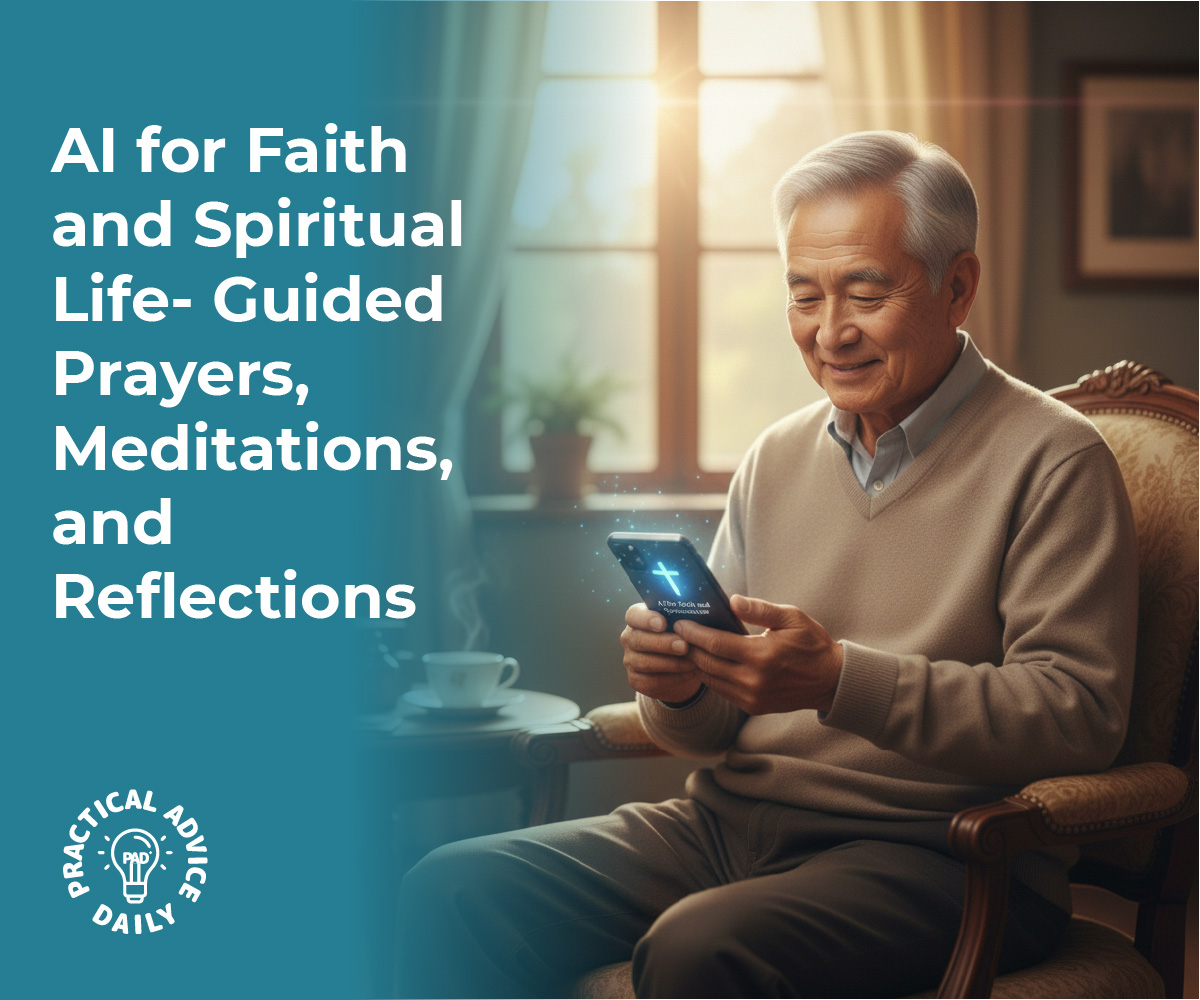
Technology can sometimes feel cold or confusing, especially when it comes to something as personal as faith. But used gently and wisely, it can also become a quiet helper—like a small lamp lighting the way, not replacing the journey.
In this article, you’ll see how AI can support your spiritual life with daily reflections, guided meditations, and prayer reminders that respect your beliefs and traditions. Everything is explained in simple, clear language, with older adults in mind.
Table of Contents
- How AI Can Gently Support Your Spiritual Life
- Ways AI Can Help With Daily Reflections
- Gentle Meditations and Quiet Time With AI
- Prayer Reminders That Fit Your Rhythm
- Respecting Your Beliefs and Traditions
- Staying Safe: Privacy and Discernment
- Simple Ways to Get Started (Step‑by‑Step)
- Practical Tips for Comfort and Ease
- Healthy Boundaries With Technology
- Final Thoughts
Key Takeaways
- AI can support—not replace—your faith. Think of it as a tool to help you remember, reflect, and stay focused, not a substitute for God, your spiritual community, or your own heart.
- You can receive tailored content. AI can offer reflections, meditations, or reminders that match your religion, denomination, or spiritual style.
- Simple tools are often best. Even basic apps or assistants can send gentle reminders, share short prayers, or suggest a verse or quote each day.
- You stay in control. You choose how often you receive reminders, what kind of content you see, and what personal information you share.
- Privacy and discernment matter. It’s wise to be careful with what you tell any app, and to check AI-generated content against your own beliefs and trusted leaders.
- You don’t need to be “tech‑savvy.” Small steps—such as asking an assistant for a short reflection—can be enough to get started.
How AI Can Gently Support Your Spiritual Life
Understanding What AI Is (In Simple Terms)
You don’t need to be a computer expert to use AI.
- AI (artificial intelligence) is a type of computer program that can:
- Understand questions written in everyday language
- Generate text, like short prayers or reflections
- Notice your patterns and gently adjust to your preferences
A helpful way to picture it:
Imagine a very fast, well-read assistant who’s always available, night or day, with ideas, reminders, and suggested words when you need them.
It does not:
- Replace God
- Replace your sacred texts
- Replace your priest, pastor, rabbi, imam, spiritual director, or community
Instead, it can sit quietly in the background, helping you keep your heart turned toward what matters most.

Ways AI Can Help With Daily Reflections
Daily Spiritual Reflections Tailored to Your Beliefs
AI can help you receive short, meaningful reflections that fit your own faith or tradition.
You might say or type something like:
- “Give me a short Christian reflection for today about hope, in simple language.”
- “Share a brief reflection from a Buddhist perspective about compassion.”
- “Offer a reflection on gratitude that doesn’t mention any specific religion.”
- “Give me a daily reflection from a Jewish perspective about trust in God.”
What AI can do:
- Suggest a key verse, quote, or phrase to hold in your heart
- Offer a short reflection (a few paragraphs) you can read slowly
- Add gentle questions, such as:
- “What is one thing you are grateful for today?”
- “Is there someone you feel called to pray for or bless today?”
Real‑life example
Mary, age 76, lives alone and sometimes feels scattered in the mornings. She uses an AI chat on her tablet and types:
“I’m a Catholic in my 70s. Please give me a simple morning reflection about trusting God when I feel anxious.”
Every morning she asks a similar question, and the AI responds with a brief thought and a line of prayer she can say out loud. It doesn’t replace her rosary or Mass—but it helps her get started.
Gentle Meditations and Quiet Time With AI
Guided Meditations in Everyday Language
AI can create simple, spoken‑style meditations you read slowly to yourself—or have read aloud by your device.
You might ask:
- “Create a 5‑minute Christian meditation about God’s peace, in very simple words.”
- “Give me a gentle breathing meditation based on gratitude to God.”
- “Write a short, calming meditation from a mindfulness perspective without religious language.”
- “Offer a Muslim‑friendly reflection I can read after my evening prayer, focused on mercy.”
What it can include:
- Breathing cues
“Breathe in slowly… hold… breathe out gently…” - Simple images
“Imagine a soft light of peace surrounding you,” or similar calming pictures - Short phrases you can repeat
- “I am not alone.”
- “God is with me.”
- “Today I choose peace.”
Tip for seniors:
- Keep meditations short at first—3 to 5 minutes.
- If reading on a screen is hard, ask a family member to:
- Print the meditation
- Enlarge the text
- Or set up text‑to‑speech so your device reads it aloud
Prayer Reminders That Fit Your Rhythm
Using AI for Prayer and Reflection Reminders
Many phones and tablets already have a simple reminder or calendar app. When combined with AI, this can become a gentle spiritual routine.
Here’s how this might work:
- Decide on your moments
For example:- Morning (after breakfast)
- Midday
- Evening (before bed)
- Ask an AI assistant to help you plan
You can type:- “Help me plan three short prayer times for each day, with simple themes.”
It might suggest: - Morning – Gratitude
- Afternoon – Strength
- Evening – Peace and rest
- “Help me plan three short prayer times for each day, with simple themes.”
- Set your reminders
Use your phone/tablet’s reminder app, or ask a voice assistant:- “Remind me every day at 9 AM to say a short prayer of thanks.”
- “Remind me at 3 PM to pause for a 2‑minute reflection.”
- “Remind me at 9 PM to review my day and say a prayer for others.”
- Ask AI what to pray when the reminder appears
When your reminder pops up, you can open your AI assistant and say:- “Give me a 2‑sentence prayer for my evening reflection, focused on forgiveness.”
- “Share a short prayer for my grandchildren’s safety and joy.”
Real‑life example
George, 82, sometimes forgets his intention to pray for his family during the day. He sets:
- 10 AM – “Pray for family”
- 8 PM – “Evening thanksgiving”
At those times, he asks his AI app:
“Please give me a short, warm prayer for my children and grandchildren, in simple language.”
It offers words he can read slowly and make his own.
Respecting Your Beliefs and Traditions
Making AI Align With Your Faith, Not the Other Way Around
Because AI is general‑purpose, you need to guide it clearly. The more specific you are, the better it can respect your beliefs.
You can mention:
- Your religion (for example: Christian, Jewish, Muslim, Hindu, Buddhist, Sikh, spiritual but not religious, etc.)
- Your branch or denomination, if helpful (for example: Catholic, Baptist, Orthodox, Sunni, Shia, Reform, Conservative, etc.)
- Your preferences, such as:
- “Use very simple language.”
- “Please include a Bible verse, but not too long.”
- “Avoid any images or wording that don’t fit Islamic teachings.”
- “Keep it interfaith and gentle, not tied to one religion.”
Sample ways to ask:
- “I’m an older Christian. Please write a gentle, non‑judgmental reflection on forgiveness based on the teachings of Jesus.”
- “I’m a Muslim senior. Give me a short reflection for after prayer that is respectful of Islamic belief and mentions Allah.”
- “I’m spiritual but not religious. Share a calming daily reflection about kindness and inner peace.”
Always remember: you are the one in charge. If something doesn’t feel right, you can ignore it, change it, or ask for a new, more accurate version.
Staying Safe: Privacy and Discernment
What You Should and Shouldn’t Share
AI tools work by processing the information you give them. It’s important to protect your privacy.
Be cautious about sharing:
- Full names, addresses, phone numbers
- Sensitive health details (unless you’re using a secure medical app approved by your doctor)
- Financial information (bank accounts, passwords, social security numbers)
For spiritual use, you can keep it simple:
- “A friend who is ill”
- “A family member struggling with addiction”
- “Someone I find hard to forgive”
You don’t need to name them. God knows who they are, even if the AI does not.
Discernment: Checking if content fits your faith
AI can make mistakes, especially with religious details. To stay grounded:
- Compare any advice or reflection with:
- Your sacred texts
- Your trusted religious leaders
- Your faith community’s teachings
- If a suggestion feels off, confusing, or uncomfortable:
- Set it aside
- Ask your priest, pastor, rabbi, imam, or another trusted guide
- Or ask the AI to correct itself:
- “This doesn’t match Catholic teaching on suffering. Please try again and be more accurate.”
You are always free to say no to any suggestion.
Simple Ways to Get Started (Step‑by‑Step)
If You’re New to Technology
You do not have to explore every feature. One or two small habits can already be a blessing.
Option A: One daily reflection
- Open your AI chat app (or ask a family member to place it on your home screen).
- Type or say:
- “Every morning, I’d like a short reflection as a Christian senior about hope. Please write one now.”
- Read it slowly.
- Underline or note one sentence or phrase that touched you.
Option B: A short nightly review
- In the evening, open the AI chat.
- Ask:
- “Give me a gentle nightly reflection as a person of faith. Include three questions I can think about quietly.”
- Answer the questions silently, or write them in a small notebook.
- End with a simple prayer of thanks, from your heart or with AI’s help.
Option C: Help finding words when you’re struggling
If you are sad, worried, or at a loss for words, you might type:
- “I feel lonely tonight. Please help me with a short prayer asking God for comfort, in kind, simple words.”
- “I’m grieving someone I loved. Please write a brief prayer I can say each morning.”
You can then change the words so they sound more like you. AI gives you a starting point; your heart completes it.
Practical Tips for Comfort and Ease
Making AI Use More Senior‑Friendly
To keep things comfortable:
- Increase text size on your device for easier reading.
- Use voice features if typing is difficult:
- Tap the microphone icon (if available) and speak your request.
- Save helpful prayers or reflections:
- Mark them as favorites
- Print them
- Copy them into a small journal or notebook
- Ask someone you trust:
- A family member, friend, or caregiver can help you set up:
- Bookmarks
- Daily reminders
- A simple “spiritual folder” on your device
- A family member, friend, or caregiver can help you set up:
You don’t have to do all the technical steps alone.
Healthy Boundaries With Technology
Letting AI Be a Tool, Not the Center
It’s easy for screens to take over our attention. To keep your spiritual life healthy:
- Use AI to point you back to:
- Scripture or sacred texts
- Real‑life prayer
- Silence and stillness
- Your faith community
- Set clear limits:
- “Just 10 minutes in the morning”
- “Only for my reflections, not endless browsing”
- If you feel more distracted than peaceful:
- Close the app
- Sit quietly for a moment
- Say your own simple prayer
AI should make your faith life richer and calmer, not more restless.
Final Thoughts
You don’t need to be “good with technology” to let AI gently support your spiritual life. With a few simple habits, it can help you:
- Remember to pause and pray
- Find words when your own feel stuck
- Reflect more deeply on your day
- Stay connected to your beliefs and traditions
Most importantly, you stay in charge. You decide what to use, what to keep, and what to ignore. Your relationship with God—or with the sacred, however you understand it—remains at the center. AI is just a small, helpful tool along the way.