
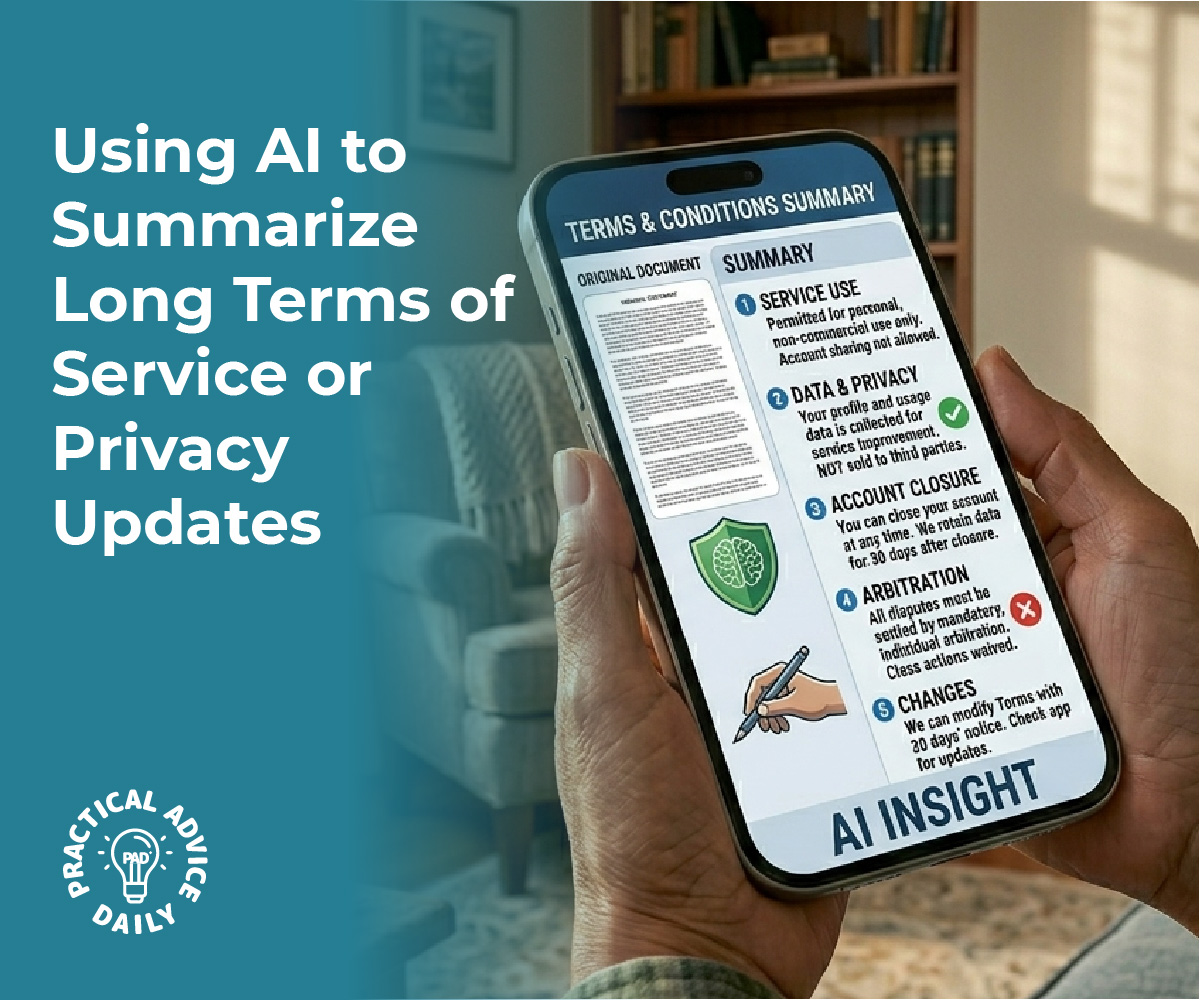
Navigating the terms and conditions of apps and services can be daunting, especially given the complex legal language often used.
Many users agree to these conditions without thoroughly understanding the implications, risking unwanted consequences such as data sharing or unexpected fees.
Artificial Intelligence (AI) tools can simplify this process by translating dense legal text into straightforward explanations, highlighting key points and potential red flags.

For anyone interested in leveraging AI to interpret the fine print, several practical methods and tools are available.
These tools can provide summaries that are quick to read and easy to understand, ensuring that users know exactly what they are agreeing to.
This empowers users to make informed decisions without getting bogged down by complicated legal jargon.
Integrating AI into this process not only enhances user awareness but also boosts confidence in making informed choices.
By learning how AI can transform their approach to digital agreements, users can navigate the digital landscape more effectively and safely.
Table of Contents
Key Takeaways
- AI clarifies complex legal terms for app and service agreements.
- Users gain confidence and safety with AI-aided decision-making.
- Efficient tools exist for quick and easy understanding of agreements.
Teaching Users How to Use AI for Explaining the Fine Print

AI can be a powerful ally in breaking down complex service agreements and privacy policies into simpler terms.
By utilizing AI, users can easily identify and understand essential details within long-winded documents before committing to any terms.
Step-by-Step Guide to Analyzing Terms and Privacy Policies With AI
To effectively use AI in dissecting the fine print, users should start by gathering the relevant documents, such as terms and conditions or privacy policies, from the app or service they are interested in.
Upload these documents to an AI-powered tool designed for text analysis.
These tools can scan and summarize lengthy passages, highlighting important clauses or potential red flags like hidden fees.
Once processed, review the AI-generated summary and flagged sections carefully.
Pay attention to privacy concerns, data handling practices, or any unusual stipulations.
If anything remains unclear, consider employing additional AI models or consulting professionals to deepen the analysis.
Selecting the Best AI Tools for Summarizing Legal Documents
When selecting AI tools, users should look for software proficient in handling complex legal language.
Tools should offer features like natural language processing (NLP), document scanning, and summary generation.
Popular tools often come with customization options to tailor the analysis to specific document types or industries.
Evaluate the tool’s ease of use and accessibility, ensuring it supports a wide range of document formats.
Compare different tools by testing sample documents or reading user reviews to gather insights into each tool’s reliability and accuracy.
Subscription costs and customer support availability might also weigh into the decision.
Key Features to Look For in AI Fine Print Analyzers
Prioritize AI analyzers that offer real-time flagging of key terms and compile brief, yet comprehensive summaries of documents.
Integration with secure cloud services is crucial for maintaining data privacy.
Look for tools that allow customization of settings to ignore or prioritize sections based on user needs.
Another valuable feature is a user-friendly interface with clear navigation options, providing a seamless experience in accessing and understanding summaries.
Offer capabilities to directly compare different versions of a document may help in spotting changes or updates.
Find tools providing a good balance of functionality, security, and adaptability.
Understanding the Benefits of AI-Powered Explanations

AI-powered explanations simplify complex aspects of contracts and agreements, making legal language accessible and boosting user confidence in decision-making.
Additionally, these tools enhance privacy protection by ensuring informed consent.
Making Complex Legal Language Simple
Legal documents often contain terms that are difficult for the average person to understand.
AI tools can break down these complex terms into simpler language, making it easier for users to grasp the essentials.
By doing this, users can make more informed decisions before agreeing to anything.
AI-powered systems use natural language processing to rephrase dense text, providing clear definitions and practical examples.
This aids comprehension and reduces the cognitive load on users who are not experts in legal matters.
Increasing User Confidence When Agreeing to Terms
When users encounter complicated terms and conditions, they may feel hesitant about agreeing because they do not fully understand the implications.
AI-powered explanations enhance the clarity of these terms, improving user confidence.
Users are more likely to commit to agreements when they feel informed about the underlying details.
AI can highlight key points, flag potential risks, and provide information on frequently misunderstood clauses.
By doing so, users can evaluate the agreements thoroughly, feeling more assured that their interests are protected.
Protecting Privacy and Informed Consent
Users often unknowingly agree to data collection and usage policies due to a lack of clarity in the terms presented.
AI helps protect user privacy by clearly outlining what they are consenting to.
By providing explicit explanations of data practices and highlighting opt-out options, users can make more conscientious choices about their personal information.
This approach promotes informed consent, ensuring users are aware of how their data is being collected, used, and shared.
AI-powered explanations support a more transparent relationship between service providers and users, safeguarding user privacy rights.
Practical Tips to Maximize AI Interpretation Accuracy
In the realm of AI, ensuring that complex terms and conditions are understood before agreeing to a service is crucial.
Leveraging AI to explain these details effectively requires careful consideration of several factors, including capturing essential details and recognizing the technology’s limitations.
Ensuring Summaries Capture All Critical Details
For AI tools to effectively summarize fine print, focusing on accuracy and comprehensiveness is key.
Algorithms should be meticulously trained on a wide variety of contracts and terms to ensure they recognize and highlight critical clauses.
Using machine learning and natural language processing, AI can identify common legal terminology.
It is important to continuously refine these models with updated datasets to encompass new types of agreements and industry-specific jargon.
Incorporating feedback loops can further enhance understanding by enabling the AI to learn from past interpretation errors.
Human oversight should be maintained to cross-reference AI-generated summaries with the original text for completeness and context integrity.
This way, users receive a balanced synthesis of the fine print that neither underrepresents nor exaggerates any aspect.
Identifying Limitations of Automated Explanations
AI’s capability to interpret legal language isn’t infallible. It may miss nuanced meanings or context, especially if the text includes ambiguous terms.
AI should flag risky language or potential areas of misunderstanding in summaries. This prompts users to read certain sections more thoroughly.
Fostering transparency about AI’s training data can help users understand the scope and boundaries of the tool’s accuracy.
For instance, AI trained primarily on commercial contracts may struggle with consumer agreements.
Regular updates and human moderation play a vital role in overcoming these boundaries.
Final Thoughts
Understanding the fine print doesn’t have to feel overwhelming or confusing. With the help of AI, you can turn long, complicated terms and conditions into clear, simple explanations that actually make sense. Instead of quickly clicking “agree” and hoping for the best, you now have the tools to pause, review, and truly understand what you’re signing up for.
By using AI as a guide, you’re not replacing your judgment—you’re strengthening it. You gain the confidence to spot important details, protect your personal information, and make smarter choices online. As technology continues to evolve, taking this small step toward better understanding can make a big difference in staying safe, informed, and in control of your digital life.